Pre-launch · open source
The freight moved. The paperwork did not.
EdrIQ keeps the order, the load, the driver, the documents and the invoice as one thing. Delivery notes and CMRs are read as they arrive instead of chased at month end, so invoicing starts when the load is delivered rather than when somebody finds the scan.
- Orders from any channel
- Documents read on arrival
- Open source, your infrastructure
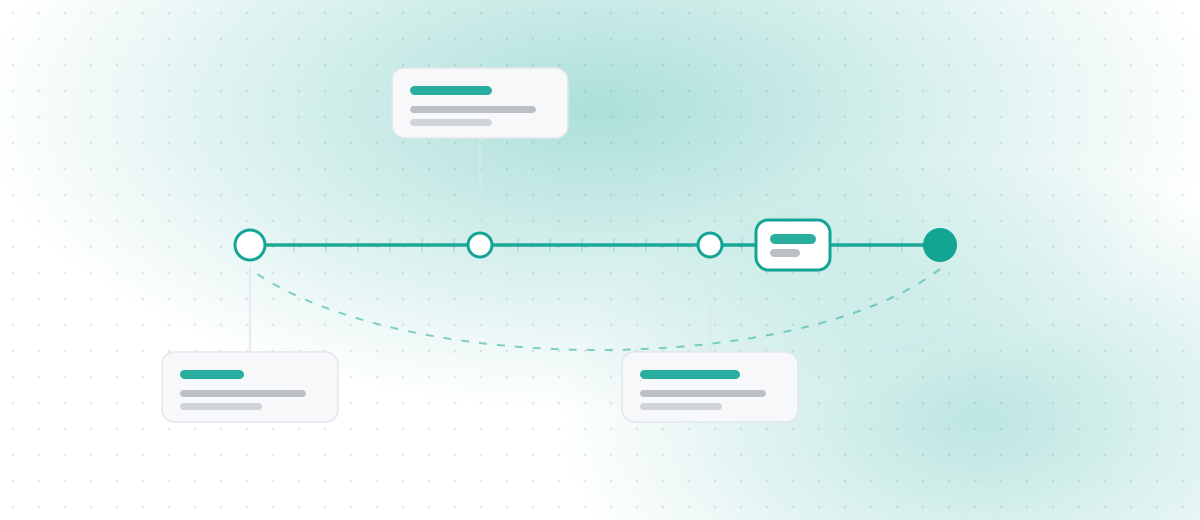
Three places where a transport company loses money it already earned
None of them is the driving. All of them are the paperwork around it.
Orders arrive in six channels and none of them is a system
Email, a PDF from a portal, a message on a phone, a call while somebody is driving. The dispatcher holds it together, which works until they are ill, on holiday, or simply have two things happening at once.
Payment waits on a photograph
The load was delivered on Tuesday. The invoice waits for the signed delivery note, which is in a cab, in a folder, or in a message thread. Weeks of cash flow disappear into the gap between delivery and documentation.
The margin is decided in two minutes
A load is quoted while the phone is still ringing, from memory, against a lane somebody last ran in March. The difference between a good and a bad price on that call is often the entire margin on the job.
In from anywhere, out as one load
The system reads what arrives rather than asking a dispatcher to retype it.
- 01
Orders in, however they come
Email, PDF, spreadsheet, portal export, a message, a photo of a handwritten note. Read and turned into a load with a customer, a route, dates and a price, waiting for the dispatcher to confirm rather than to type.
- 02
One load, start to finish
Quote, assignment, driver, vehicle, stops, documents and invoice on a single object. When somebody asks where that job stands, the answer is in one place instead of four.
- 03
Documents read themselves
Delivery notes, CMRs and weighbridge tickets photographed by the driver and attached to the right load automatically, with the fields extracted. Invoicing starts when the proof lands, not when somebody goes looking for it.
Six parts of a forwarding week
Built around how a small carrier or forwarder actually works, rather than around the modules a large ERP happens to sell.
Order intake from any channel
The enquiry becomes a load without anybody retyping the address, the reference or the loading window. Corrections train it for that customer rather than being repeated every time.
Loads and dispatch
Who is where, what is assigned, what is still open, and which loads are at risk today. One board rather than a spreadsheet that only the dispatcher can read.
Documents on the load
CMRs, delivery notes, supplier invoices and customs paperwork attached to the job they belong to and searchable — including the ones that arrived as a photo taken in a dark loading bay.
Invoicing that starts at delivery
The invoice drafted when the proof of delivery lands, sent after a person checks it, and followed up on schedule. This is where most of the money in this product is.
Lane memory
What you charged for this route before, what it cost, and how it went. Available in the two minutes when the price is actually being decided rather than in a report at month end.
Open source, on your infrastructure
Your order history is yours, in your database, in a system somebody else could maintain. Changing supplier should not mean losing five years of what you charged and to whom.
What this is not, stated clearly
Transport has real regulatory systems with legal weight attached, and software that is vague about which of them it covers causes expensive misunderstandings. EdrIQ is an operational system. Where it does not do something, it will say so on this page rather than in a footnote after the contract.
- Not a tachograph or driver-hours tool. Working-time analysis is a specialist regulated area, and we will integrate with the tools that do it rather than claim to replace them.
- Not a replacement for national reporting or tolling systems. Electronic tolling and road-freight reporting obligations stay where they are; any integration will be named and dated when it exists.
- Not customs clearance. Documents can be attached and found, which is useful; the declaration remains with whoever is authorised to make it.
- Not a promise about accuracy. Extracted document fields are checked by a person before they reach an invoice, because a wrong reference number is a rejected invoice.
Why an open system matters more in transport
Margins are thin, seats are many, and the asset that accumulates is history: which lanes you ran, at what price, for whom, and how it went. That history is the thing a transport company should least be willing to leave behind when it changes software, and it is exactly what conventional licensing makes hardest to take.
- Per-seat pricing punishes dispatchers. A company with six people in the office pays six times for a system where the value is in the loads, not the logins.
- Your history is your pricing power. Five years of lanes and rates is the most valuable data a forwarder has, and it should not live somewhere it cannot leave.
- Small carriers are not small versions of large ones. Products built for fleets of four hundred assume roles and processes that do not exist at twelve trucks.
- Somebody else can maintain it. The code is public, so the supplier can be replaced — including when the supplier being replaced is us.
Running on real loads, but not for customers yet
Transport software that has not survived a real month of real deliveries should be described accordingly.
- Now
Real loads, our own risk
Orders, documents and invoicing running against actual movements, so the failure modes we find are ours rather than a customer's.
- Next
The first few carriers and forwarders
A small number of companies, set up with help and watched closely. Dispatchers are the most useful critics in this industry and the least likely to be polite about it.
- Later
The regulated integrations
Structured e-invoicing, telematics and the reporting systems that carry legal obligations. They come after the core is proven, and each will be listed with what is supported and what is not.
Frequently asked questions
What is EdrIQ in one sentence?
An open-source operating system for transport and forwarding companies that reads incoming orders and documents, keeps everything about a load in one place, and starts the invoice when the delivery is proved.
Does it replace our TMS?
That is the intent for small and mid-sized carriers and forwarders. For a company running a large specialist system it is more likely to sit alongside it at first, and we would rather say that than claim a migration we cannot yet support.
What about driver hours and tachographs?
Not covered, deliberately. Working-time and tachograph analysis is regulated specialist software and getting it slightly wrong has consequences for a company beyond an inconvenience. Integration with the tools that do it properly is the plan.
Does it handle electronic tolling and freight reporting obligations?
Not today. Those are national systems with legal weight, and any integration will be named, dated and described precisely when it exists rather than implied on a homepage.
Do drivers need an app?
They need to be able to send a photograph, which every driver can already do. A simple app makes it tidier, but a system that only works if every driver installs and learns software will not survive contact with a real fleet.
Does the AI send anything to customers?
No. It drafts — the quote, the invoice, the follow-up — and a person approves. In a business where a wrong reference number means a rejected invoice, that boundary is the design rather than a limitation.
What will it cost?
The software is open source, so self-hosting costs infrastructure and your time. A managed option will be priced per company rather than per user, because charging a forwarder for adding a dispatcher is the model this is arguing against.
Can we get our data out?
It is in your database in the self-hosted version, and exportable in full in any other. Your lane history and rate history are the most valuable things here, which is exactly why they should not be hostage to a subscription.
Tell us where your week actually goes
The waitlist form goes live soon. Until then the blog explains what is being built and what is deliberately not.
No form yet, no data collected — just come back.